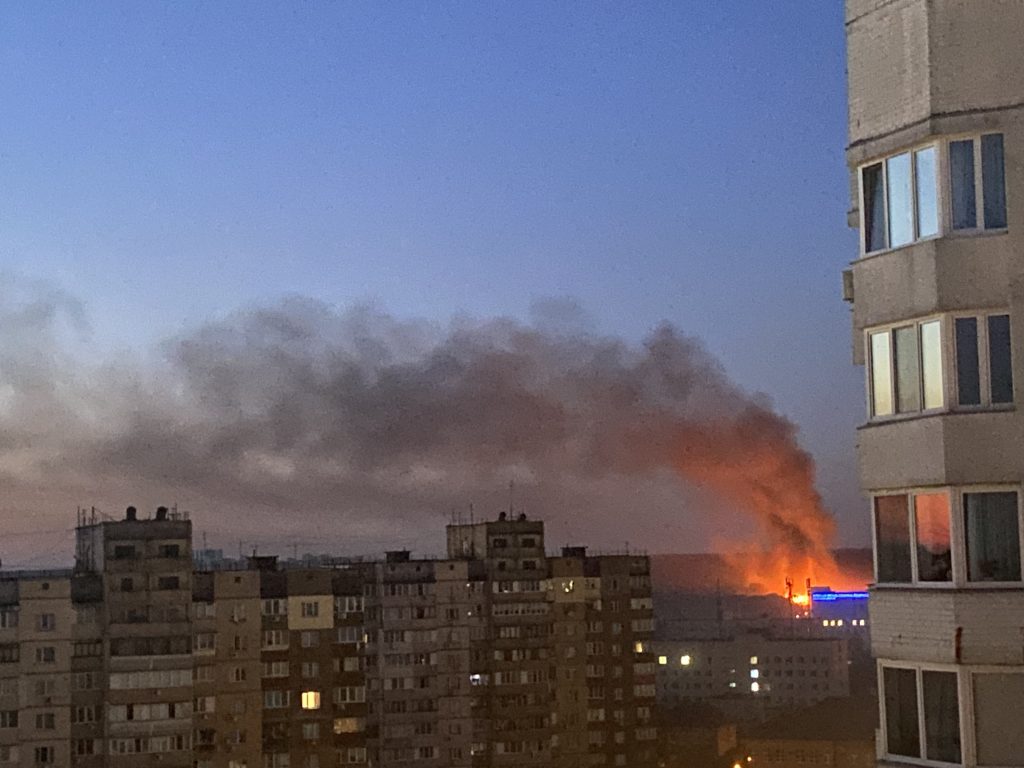
I am writing this from a train carriage. Because of my work and family situation, I travel to Kyiv by train very often. Nominally, the trip takes about three and a half hours. But “nominal” time no longer exists in Ukraine.
Recently, railway stations—and the trains themselves—have increasingly become targets for drone and missile strikes. To protect passengers, the Ukrainian railway system has implemented strict safety protocols. Trains are often forced to halt in safe areas for hours, waiting out the attacks.
This time, our train was stopped just outside the Kyiv Central Railway Station. We waited there for almost two hours, listening to nearby explosions. We were not evacuated; it was safer to remain on board because, at that exact moment, the Central Station itself was under heavy attack by kamikaze drones.
When the train finally pulled into the platform, the passengers who boarded our carriage were in deep shock. They had spent those same two hours trapped in the station’s underground shelter. One woman explained that when she finally tried to step out, the blast wave from an explosion physically threw her backward into the underpass.
Another woman next to me had just fled an institution that was struck by a drone moments earlier. At first, her response was purely clinical. She called her relatives, calmly explaining that her workplace was destroyed and she was heading home. But a few moments later, the shock wore off. She began to cry uncontrollably. Only then did her mind process the terrifying truth: she had survived by a matter of minutes.
This is the exhausting rhythm of Kyiv. Alarms ring almost around the clock. Recently, the government introduced a two-tier siren system to help us navigate the chaos: yellow signals for drone attacks and red signals for missile attacks. During a yellow alarm, we are permitted to go about our routine. During a red alarm, we must seek shelter.
So, during the day, we split our realities. We work, we buy groceries, and we even go to concerts under a yellow sky—knowing full well that the risk of dying from a drone strike can be just as high as a missile. We gamble with normalcy because the alternative is to stop living entirely.
But the night always demands its toll.
At 1:00 AM, the siren wailed again. A red alarm. Extensively exhausted from the day’s psychological weight, my body refused to move. I missed the mental cue to wake up and head to safety. The next moment, I was violently jolted from my bed. A deafening explosion shattered the silence, shaking the walls of my building. In that split second, the illusion of normalcy vanished, leaving only the raw, pounding reality of survival.
One week later, I find myself at a railway station again. This time, I am in a theoretically “safer” region of Ukraine, waiting for my train back to the capital. But safety here is a relative term, an outdated concept. Just one hour before my scheduled departure, Russian drones strike and destroy the power supply system of several railway stations.
The entire line is de-energized. Trains are delayed by three, five, seven hours. By the time I finally arrive in Kyiv, it is far too late to go home before the citywide curfew takes effect. Fortunately, I still have time to reach my hospital.
The moment I step out of the train car, the air raid sirens go off immediately. I have a 15-minute walk to my hospital through completely empty streets. Kyiv, usually a beautiful night city, transforms into a scene from an apocalyptic movie within minutes as a swarm of drones begins attacking directly overhead. I practically burst through the entrance of my hospital department, flanked by the terrifying roar of jet-powered drones and the thunderous reply of air defense systems in action.
I manage to lie down to sleep in the observation room. At 3:00 AM, a colleague runs into the room with terrifying news: ballistics are heading straight for Kyiv. We sit together, shuddering from the impacts, quietly counting the “arrivals” hitting near the National Children’s Hospital. The children in our department are safely tucked into the shelter below. But we stay upstairs in the department because we have a severely bedridden patient who simply cannot be transferred to the subterranean bunker.
We do not cry. We do not panic. We just sit there, methodically accounting for the explosions and checking the news on our phones to see what was destroyed, how many were killed, and what parts of the grid were de-energized. Amidst the chaos, we are already thinking about how we will manage to commute home tomorrow.
In the morning, the routine text messages from relatives arrive: “Are you alive?”
Our colleagues, who arrive late because of the inevitable transportation collapse caused by the alarms, ask us the usual questions: “How did you survive? Where did you sleep? How loud were the explosions?”
These have become our everyday questions. We answer them with jokes, with tired smiles. But underneath the smiles, we are exhausted. We are utterly depleted by the daily stress, the constant vigilance, and the perpetual worry for our families and the people we love.
We worry about tomorrow—if tomorrow will even come. We worry about what we will eat when the product warehouses are systematically targeted and destroyed. What will our children eat if our entire economy collapses under the weight of this destruction? How will we survive this winter in apartments that might drop to zero degrees, just like last year? Or worse, what if we are left with no roof over our heads and no windows in our walls?
Every day, the logistical nightmare of parenthood in a war zone repeats itself. How will our kids go to school today, and where will they be safer—in the school shelter or the home shelter? Will their classes and clubs be online, offline, or canceled altogether? If they are at home, someone has to be there to guide them to safety when the sirens scream.
This is our routine. It is a literal, daily survival—without a shred of hyperbole.
Inside the walls of our hospital, we try our best to provide routine care. For our patients, we fortunately have all the necessary medicines and diagnostic tools. However, as the central state hospital, we provide medical services to children from all over Ukraine. Across the country, the healthcare situation varies drastically from region to region, heavily dictated by a location’s proximity to the front line and countless other social factors.
Some children in pre-frontal regions cannot even reach their local regional hospitals due to permanent shelling, drones, and guided aerial bombs. Yet, many people in these front-line zones refuse to move away from their heavily targeted cities and villages.
Recently, a 14-year-old boy arrived at our department from one of these pre-frontal territories. He had developed severe side effects from his antiretroviral therapy—specifically a toxicity to tenofovir, which we recognized at first sight. He only ended up in our hospital because the pain in his legs had become so excruciating that he had almost entirely stopped moving.
His grandmother explained that in their city—a place once famous for its manufacturing—there is not a single pediatrician left. They had all fled the relentless shelling by russian troops. A few weeks prior, a drone had struck their very house. Because of the constant danger, the boy stayed indoors almost 24 hours a day. His school was closed, leaving him with nothing but online classes. For months, his world had been confined to the walls of his home, and his only physical reality was the extreme pain caused by the medication.
I asked the grandmother why they hadn’t traveled to Kyiv sooner to get him help. She looked at me and confessed that she was simply too terrified to travel to Kyiv. To her, escaping a front-line city felt less dangerous than boarding a train, because russian troops deliberately and systematically target trains, buses, and even ambulances.
I found myself smiling at the tragic irony of it—how strange it sounds to be afraid to move from one danger zone to another that is almost exactly the same. But then I remembered my own recent train trips: the grueling delays, the suffocating stress, and the sheer terror of wondering what happens if you are trapped inside a closed metal carriage during an active bombardment.
I looked back at the boy. He is 14 years old—the same age as my own son.
He was severely underweight, his legs painfully thin. Set against his gaunt face, his large eyes looked deep, sad, and devastatingly tragic. He spoke to his grandmother with an intense, quiet seriousness. There was no teenage joking, no easy-going youth left in him. He did not smile. Those eyes looked straight into my soul.
Listening to his grandmother’s stories, watching his calm, stoic posture, I was reminded of the endless stories I hear every day from parents, grandparents, and children who are marching through the meat grinder of war, pain, and suffering. I realized that this boy, like millions of our children, has already survived a lifetime of trauma. He has been entirely robbed of a happy childhood.
How many more boys and girls are hiding in dark shelters right now? How many children go to school every day, or sit at home, running the high risk of being killed in the middle of their “routine” lives? How many are enduring forced migration, or the painful separation of their parents as families search for safety? How many children have already been killed, or tortured under russian occupation?
How long can this cruel, meaningless war continue?
Unfortunately, I do not have the answer. But I hold onto a fierce hope that the international community will choose to be more than just “deeply concerned.” They must find the resolve to truly influence the end of this war.
Never again should mean never again.
Written by Vira Chechenieva, MD Pediatrician, paediatric infectious disease doctor, SNCE«National Children’s Specialized Hospital «OKHMATDYT» Ministry of Health of Ukraine, Kyiv, Ukraine PhD candidate, Department of Pediatric Infectious Diseases National Pirogov Memorial Medical University, Vinnytsia, Ukraine