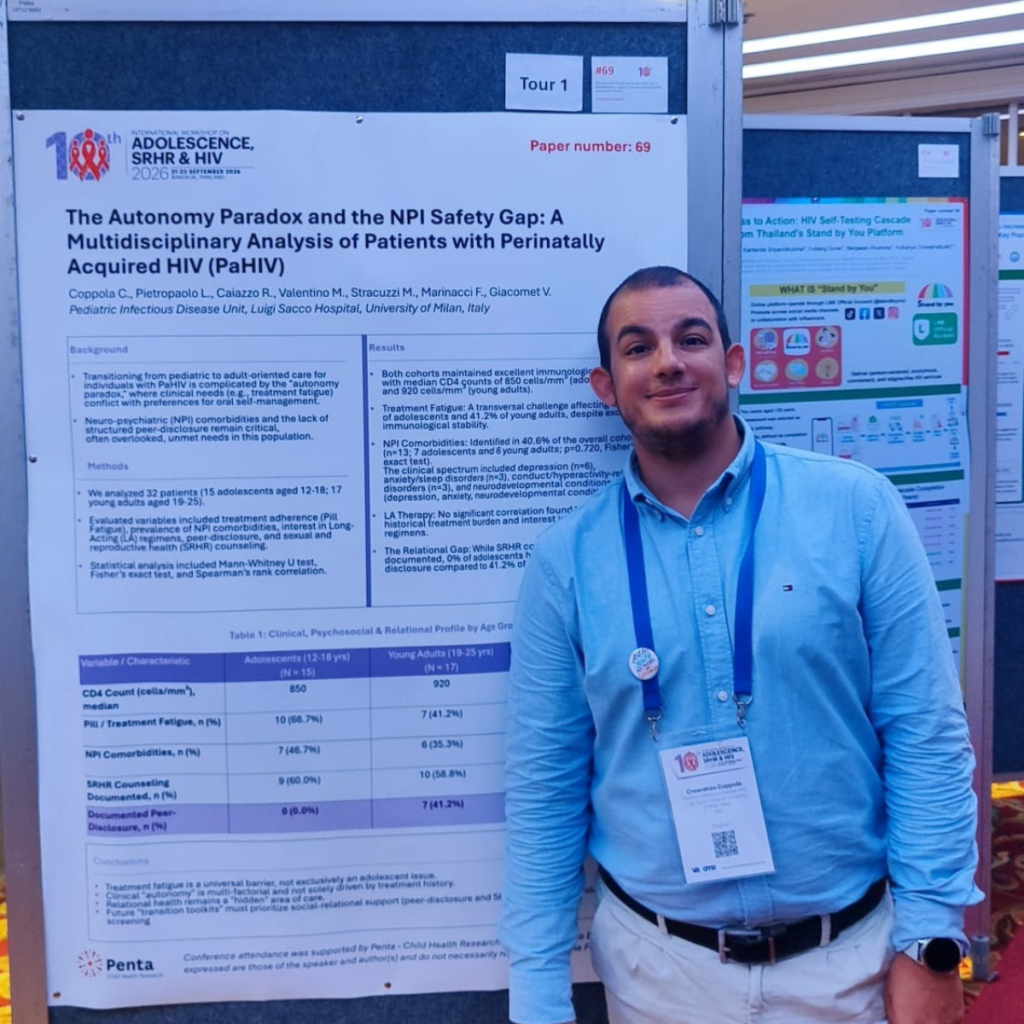
Attending the 10th International Workshop on Adolescence, SRHR & HIV in Bangkok as a Penta ECR travel awardee was one of the most useful three days of my career so far. I had the opportunity to present two posters from our group at the Luigi Sacco Hospital’s Pediatric Infectious Disease Unit in Milan: an analysis of the “autonomy paradox” in adolescents and young adults with perinatally acquired HIV, and an organizational audit comparing traditional referral pathways with a hub-integrated model for adolescent SRHR and biomedical prevention services.
The single scientific thread that resonated most with me was the growing evidence base around long-acting antiretroviral prevention and treatment.
Between the dedicated sessions on long-acting injectable PrEP and ART, and a genuinely lively debate on whether LAI treatment should be reserved only for patients with adherence challenges, it was clear the field is moving past the “if” of long-acting regimens and into the harder “how”: how to maintain adolescents on these regimens long-term, how to manage the logistics in resource-limited settings, and how to avoid simply replacing one form of dependency on the health system with another. This connects directly with a systematic review on CAB-LA PrEP in adolescents I am currently leading, and hearing real-world implementation data from Uganda, the US and South Africa gave me concrete material to bring back to that work.
Beyond long-acting therapies, two themes stood out as likely to shape the next few years of adolescent HIV care: the transition from paediatric to adult-oriented services, which several groups are now trying to formalize into structured “transition models” rather than leaving it to local practice; and the integration of mental health support directly into HIV clinics, rather than treating it as a parallel referral pathway. Both map closely onto gaps we are trying to describe and address in our own cohort of adolescents with perinatally acquired HIV.
What made the workshop more than just a conference for me was the Penta ID Network itself. Meeting fellow ECRs, co-authors from partner sites, and more senior investigators I had previously only known through papers turned abstract collaborations into real working relationships. A true highlight was the guided poster tour with Dr. Caroline Foster, which provided a fantastic moment of shared knowledge and direct feedback.
For an early-career researcher, that kind of access and mentorship is hard to replicate outside a network like Penta, and it is exactly the kind of opportunity this travel award was meant to create.
Written by Penta Early Career Researcher – Cresenzo Coppola