This article was written by Penta Young Reporter, Arlene. Find out more about the Penta Young Reporters here.
What is CHIVA?
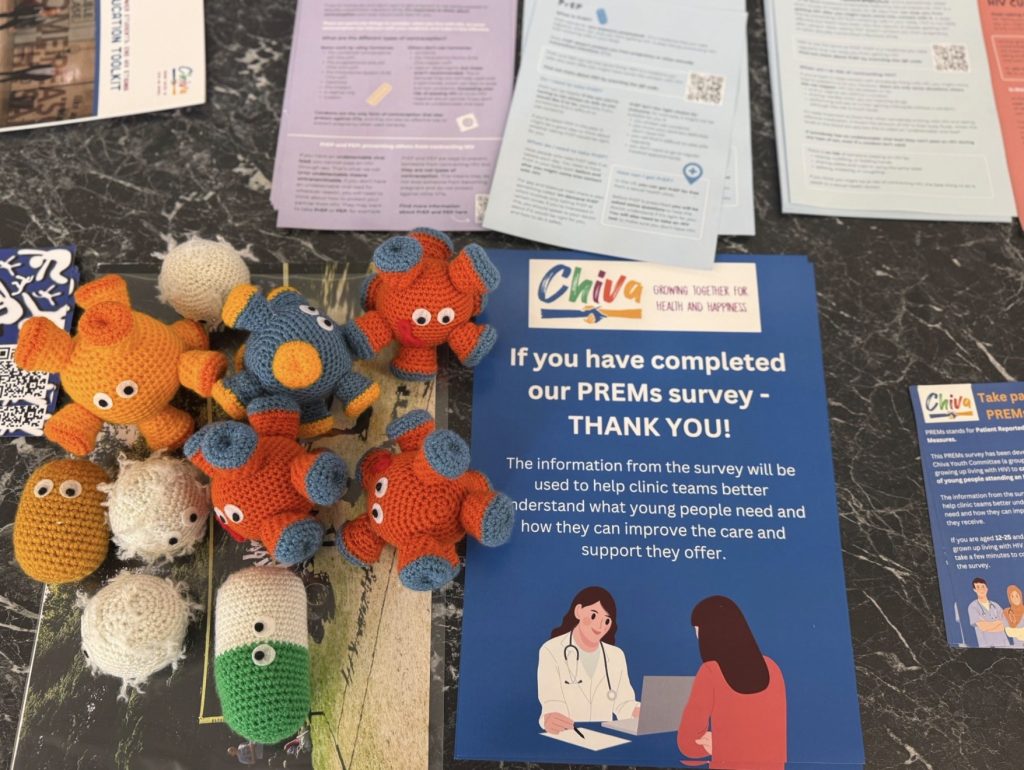
The Children’s HIV association is a charity in the UK dedicated to ensuring that “children, young people, and young adults who grow up with HIV become healthier, happier, and more in control of their own future”. They do this through peer support, camps, educational projects and workshops, as well as guidance from professionals.
CHIVA Youth Committee (CYC)
Who are the CYC you ask? They are an amazing group of young people who help advise a wide range of projects and campaigns whilst working alongside CHIVA staff, trustee board, and steering groups.
During the conference, the CYC performed a creative piece consisting of hands up hands down and role play, to discuss long-term health and living healthily with HIV. This introspective piece was thought-provoking, and challenged the assumptions of the audience. It first consisted of the CYC asking members to put their hands up if they think a statement is true or false. One of the statements was “80% of the CYC feel their HIV healthcare professionals have given them the correct amount of information about transitioning into adult care” ; this statement was false, as only 37% felt fully informed about transitioning. According to the CHIVA transitioning guide, transitioning is described as a planned process that addresses medical, psychosocial, & educational/vocational needs of young people that are transitioning from child-centred care to adult-centred care. Exposing the professionals in the audience, who research and take care of people living with HIV, to the realities of what the committee face was impactful and brave. The performance shed light on what many young people who transition may feel, but do not have the ability to say, and they put a spotlight on gaps within care. I admire the CYC for using such an elaborative and creative approach to discussing their experiences, meeting them was one of the highlights of my time at the conference.
The workshop on the importance integration of psychosocial support into HIV care
A lesson, case study, and acting wrapped up into one workshop.
This workshop looked at the multifaceted realities of the lives of young people living with HIV, and how a dynamic, psychosocial approach to their care can cause an impact. The workshop particularly focused on trauma, and early on trauma was established as not just emotional, but also physiological. They explained that when trauma occurs, the amygdala (part of your brain that helps detect threats) is overactive, and the prefrontal cortex (the part of your brain that manages executive functions) goes offline. The integration comes from the recognition of where trauma may lie, we were able to see this through the roadmap of psychosocial integration that explores different areas like home life, education, sexuality and more. Another part was to recognise trauma masks. For instance behavioural trauma masks may be a person’s people-pleasing or aggressive behaviour, and a physical/somatic symptom could be unexplained aches or sleep disturbances.
After we role-played a case study of a young adult, my group looked at a scenario that explored the difficulties in sexuality and how that can further affect a young adult living with HIV. I found it so interesting to see the approach everyone was taking; I was not so great at this, I ended up diverting away from the point, and was a little bit lost on how I should approach this young person even as a young person. I particularly enjoyed the approach of the sexual health specialist, they first introduced themself and communicated that all things discussed are confidential. The way they approached the individual allowed for a conversation to flow, and for the issue to be addressed. It was new and refreshing, as they were quite honest and upfront, and talked to the person like a person, not just as a patient. The biggest thing I took away from this workshop is the importance of not seeing a person just as their condition, but as to all the things that make up them, the bigger picture of what they experience within life and its impact. As a person living with HIV is not defined by their status, but they are defined by the measure of who they choose to be, whether it is their goals, aspirations, interests and so much more. However they are also affected by so many other factors from life, just like any other person, and acknowledgement is integral.
Professor Maryam Shahmanesh : The new HIV treatment, prevention, and research funding the environment : Impact on the UK
After listening to Professor Shahmanesh talk I felt empowered, like I could do anything, there was a fire for change and advocacy that echoed throughout her entire segment. She talked about how community, advocate solidarity, and communication are driving forces for change. One of her initial points is that there are still 1 – 1.96 million new HIV infections each year, this is significant as it shows that there is still work to be done, despite the massive strides taken within HIV treatment and prevention.
Funding was then addressed as global health funding has decreased ; this cuts into research grants increasing the competition rations (ie unitaid 130 : 2 or Gates challenge grant 360 : 1). The decrease in funding impacts vulnerable key populations the most. When HIV/AIDS services decrease, signage is taken down, and advocacy is muted, who are people living with HIV, specifically key populations, meant to turn to – especially in lower-income countries that rely more on funding for these services. Places like the United Kingdom cutting global aid from 0.5% of gross national income to 0.3%, can greatly affect these communities and cause impact on the care people living with HIV/AIDS are able to access. There are benefits to funding research outside of what the research was initially designed for, as things like the COVID-19 test kit uses the lessons learned from HIVST, the framework developed for HIV self testing itself. Further signifying the importance of funding, and how this can benefit not just the target groups but everyone.
I spoke to the professor afterwards and I wanted to know what I could do, where I could make an impact ; her answer was simple, throughout her speech she conveyed that science is political so the main answer was to get involved, not just acknowledging the science but also the politics impacting and encompassing it.
Honourable mentions
I spoke to positively UK, a charity that supports and advocates people living with HIV. They have peer-led support groups for women, men, and workshops for newly diagnosed people or women living with HIV looking to plan for pregnancy. These events help build community amongst those who have HIV, I feel like community is so important not just to foster a sense of belonging, but also to allow yourself to grow in a safe space. There is so much more information on their website, you should go take a look!
There were more amazing speakers like Dr Merle Henderson who spoke about ageing perinatally (this describes the period before during and after birth) with acquired HIV, or Professor Intira Jeannie Collins who spoke about the CHIVA research plenary, and much more.
I left the conference in awe, and all I knew was that I have so much more to learn, I was truly inspired by each and every person in that room.
Now, I have to ask myself and you the reader, what comes next. Will you become an activist for those impacted by HIV/AIDS, an ally in solidarity for causes like CHIVA, or will you simply learn something new?